
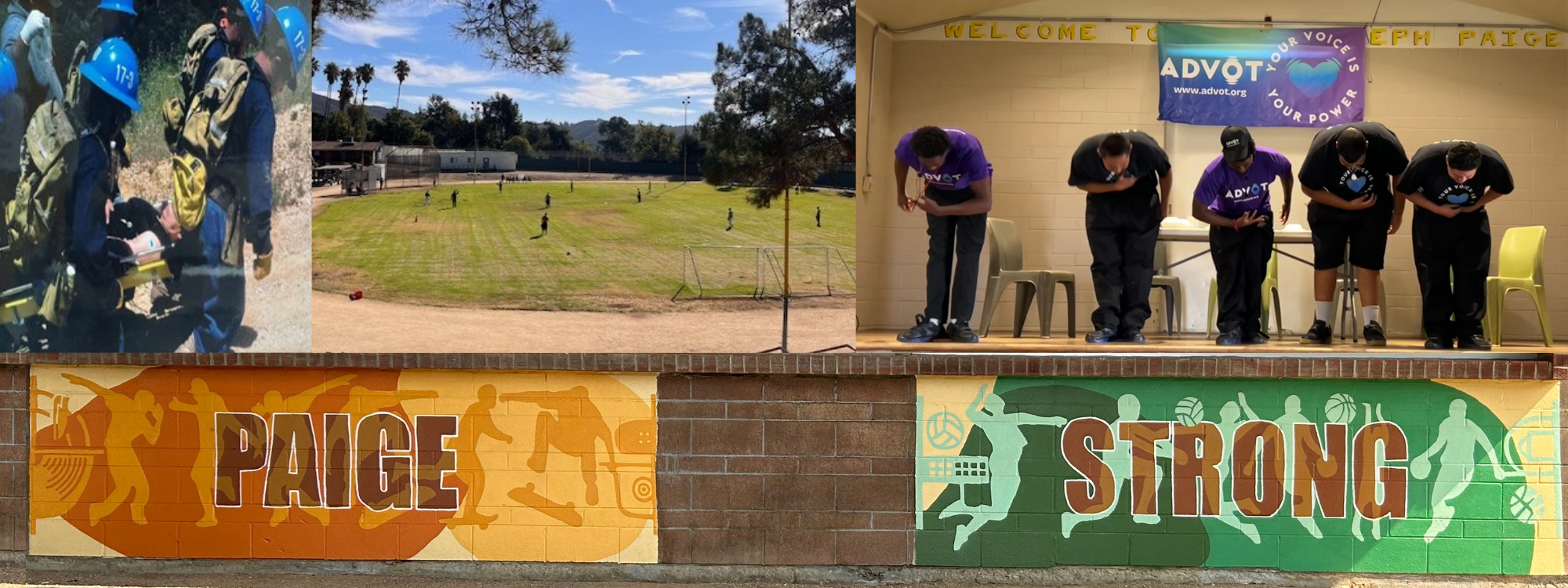
Once a highly respected fire camp, Camp Joseph Paige was originally established to train justice-involved young men in basic firefighting techniques, such as brush clearance, in support of the Los Angeles Fire Department. Though the fire training component has since been dissolved, the facility now serves as a rehabilitative environment for youth ages 16 to 19, fostering a culture of care, personal growth, and transformation. The camp focuses on shifting the mindset and behavior of young people who have experienced trauma, offering an intensive, evidence-based program.
Located in the foothills of San Dimas, Camp Paige features an open dormitory setting with the capacity to securely house up to 48 youth. As a post-disposition placement for male probation youth, the camp provides a home-like atmosphere designed to support rehabilitation and reintegration. Under the direction of the juvenile delinquency court, youth typically complete a 5–7 or 7–9 month stay.
Youth at Camp Paige engage in a variety of enriching, hands-on programs including job-readiness training, college coursework, silk screening, graffiti art, theater, music, animal rescue interactions, and healing circles. These multifaceted activities are designed to promote mental wellness, build life skills, and boost self-confidence—preparing youth for a brighter, more hopeful future.
Camp Paige’s programming includes:
- Wolf Connection – The program, in collaboration with the Department of Mental Health (DMH) empowers youth to connect with their authentic selves as they experience relationships with rescued wolves and the natural environment. These deeply intuitive animals inspire young people to be fully present in their bodies, release ideas and behaviors that no longer serve, and understand their unique role in a human “pack” or community. Youth learn to forgive and give themselves and others the love and respect they deserve.
- Bender’s Book Club – This probation lead program enhances reading comprehension, vocabulary expansion, improves focus, builds confident and much more. Youth are permitted to select a series of urban literature written by various popular authors. Prior to exchanging the book, they are required to submit a thorough book report and participate in hosted group discussions on the book’s content.
- Homeboy Art Academy – Homeboy Art Academy (HAA) is a trauma-informed arts center that provides culturally competent and asset-based arts education and community convening’s, serving 150 system-impacted youth and adults each year in Los Angeles County. The HAA program is broken up into the following categories: Prevention,
Diversion, and Intervention that consist of mentorship and art and healing workshops. HAA opens its doors to provide intensive mentorship, arts education. HAA provides 12-16-week courses 2x a week for the duration of 1.5 hours to Camp Paige youth. In these workshops they gained the opportunity to share of their true self corresponding to the intentionality of the exercises which helps provoke thought and emotion into dialogue in sharing. CJP youth are encouraged by HAA facilitators, Dario and Giovanni, throughout the program to develop or enhance their artistic expression. They work together as team on art design and artistic mediums which can be observed throughout the CJP facility.
Camp Visitation:
Family visitation is a vital component of the rehabilitation process and is strongly encouraged by the Probation Department. Through this process youth are provided an opportunity to engage in conversations under the supervision of Camp Staff. Once a youth arrives in Camp they will be requested to provide a list of relatives including mother, father, legal guardians and grandparents. During the orientation process each youth is informed of the facility’s visitation schedules, rules and procedures, and is provided a Rules and Rights Handbook, that also stipulates visitation rules and procedures. Family may visit on Sunday from 1:00 PM-4:00 PM.
Please note:
- Approved visits are limited to parents, legal guardians, or persons standing in loco parentis, grandparents and children of youth. A legal guardian must bring verification to the facility to be approved.
- Visits by persons other than those listed above are considered Special Visits, and require prior permission, that may be obtained via a court, DPO, or facility management.
- Youth’s minister, priest, rabbi, or other authorized religious chaplain may visit on weekdays with coordination from the appropriate religious facility coordinator. They are not allowed to visit during regular visiting hours this is considered a Special Visit.
- All visitors must be at least 21 yrs. of age, unless authorized by a court order, which would then be classified as a special visit and would require permission as listed above.
- Visitors must bring a valid government issued photo identification to be cleared to enter the facility and are not permitted to bring any items other than one (1) key on a single key ring and their identification.
- All visitors are to be appropriately dressed and must wear closed toe shoes.
- Visitors are not permitted to bring personal items to youth.
- Once verified all visitors are subject to search. Note: Visiting hour searches are conducted by narcotic detection canines.
Information last updated October 27, 2025